Delivered by Amy Higgins on June 11, 2023
Scripture: Matthew 9:9-13, 18-26
The late anthropologist Margaret Mead was once asked by a student what she considered to be the first sign of civilization in a culture. Expecting her to talk about utensils or clay pots, the student was surprised by his teacher’s response. Ms. Mead answered that the first sign of civilization in an ancient culture was a femur (thighbone) that had been broken and then healed. She explained that in the animal kingdom, a broken leg means death. Without the ability to run from danger, hunt for food, or find a water source you become the food for prowling beasts. No animal survives a broken leg long enough for the bone to heal.
Today’s passage in Matthew is about healing. There are the obvious healings of the two women but, there are less obvious healings as well. The passage begins with Matthew answering the call to follow Jesus. We have no explanations. Had Matthew heard of Jesus and what he was doing? Was Matthew tired of his job, despite the perks, and decided to jump at the first offer of a new career? Why did he get up and follow without a word? This passage does not tell us and does not even give us anything to infer. All we know is Matthew got up from the tax collector’s booth and followed Jesus.
But then we jump to Jesus having dinner at Matthew’s house. Other tax collectors and sinners came and ate with Jesus and the disciples. Then somehow the Pharisees found out and grumbled to the disciples. The Pharisees complained to them that their teacher should not associate with sinners and tax collectors. Tax collectors who have not only sold their souls by aligning with the empire, but they also abused their position and took further advantage of their neighbors for their own gain. They looked out only for themselves and did so at any cost to others, placing their loyalty with despotic leaders to save themselves no matter the harm it brought to the neighbor. Why did Jesus associate with those who worshipped the empire? Jesus answered, “It is not the healthy who need a doctor, but the sick…meaning, I desire mercy, not sacrifice. For I have not come for the righteous, but sinners.”
And here, the teacher quoted the Old Testament, the Torah, specifically the book of Hosea. Chapter 6, verse 6 to be exact. But the lectionary calls for us to begin with the last verse of Chapter 5. “Then I will return to my lair until they have borne their guilt and seek my face- in their misery they will earnestly seek me.” It is easier to believe God turns away from us but, He does not. He is always with us, waiting until we are ready to see Him, to seek Him. Chapter 6 begins, “Come, let us return to the Lord. He has torn us to pieces but he will heal us…he will revive us…he will restore us…” We tear ourselves, and each other apart, but we blame God because He give us the free will to do so. But even when we blame Him, He is still there to heal us. No matter what we do or how much we blame Him, He will restore us. The passage goes on to describe God as like the rains “that water the earth” and our “love is like the morning mist, like the early dew that disappears.” God is the nourishing, life-giving water but, our love for Him and each other can come and go like the morning dew disappearing with the sun. And then the sixth verse, “For I desire mercy, not sacrifice, and acknowledgment of God rather than burnt offerings.” God does not want us to sacrifice His creation, He wants our mercy for His creation and our acknowledgement of Him in all things, especially one another. God wants our love to be steadfast – like nourishing rains not vanishing morning dew. And maybe then, we will not be blind.
Jesus was not here for the righteous, but for sinners. He entered Matthew’s world, sat at his table and ate with sinners. Of course if Jesus had refused to ever eat with sinners as the Pharisees implied, he would have always eaten alone. He could not have even eaten with the Pharisees. But Jesus broke bread with them. He did not preach. He sat with them. He kept them company and gave them grace, truth, and compassion. Jesus’ ministry was with the sick and sinners And in his withness, W-I-T-H, withness, we see that maybe we need to change the company we keep.
To some, it seemed odd the lectionary this week would skip over the passage about new wineskins and move to the healing of the two women when looking at the calling of Matthew. But there is a connection. After the meal at Matthew’s house, Jesus followed a synagogue leader to where his deceased daughter lay. A synagogue leader who believed Jesus could heal her sought him out despite the criticisms of the Pharisees. On their way, Jesus was interrupted by the woman who had been hemorrhaging for twelve years. These two healings seem to be unrelated, with the father and this woman seeming to have nothing in common but, they do. Yes, the woman tried to hide and the synagogue leader was open about seeking Jesus’ help. The woman had been hemorrhaging, she was unclean and the synagogue leader was a clean, holy man. But they both were living out what we heard earlier in Psalm 50 an in the passage from Hosea. They did not offer burnt sacrifices. They brought only themselves. Their sick and sinful selves. And by their faith they received the healing they sought. Their hurts were their own and were healed by their own faith not by the belief of others, what they were told to believe. And in answering the call to follow Jesus, defying the empire and the Pharisees, Matthew was also healed.
Matthew was healed from his former life. Being called and living into that call saves us from ourselves, from who we used to be – our false, inauthentic selves that are not who God created us to be. And in this healing, like Matthew, we are restored to the life God intends for us and restored to the community. Margaret Mead went on to explain why a healed broken bone is the first sign of civilization in a culture saying, “A broken femur that has healed is evidence that someone has taken time to stay with the one who fell, bound the wound, has carried person to safety and has tended the person through recovery. Helping someone else through difficulty is where civilization starts.”
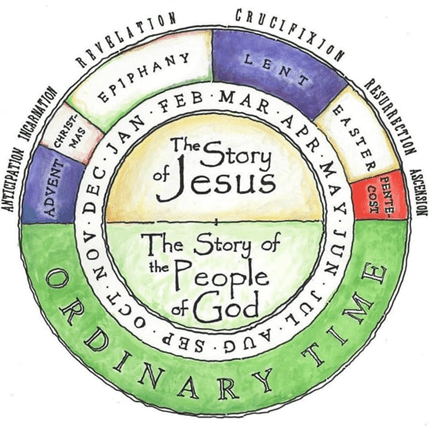
We have entered what is called “Ordinary Time” in the church calendar. But ordinary does not have the meaning we normally associate with that word. It is ordinary in that this half of the year is ordered or measured. We have gone through the story of Jesus. We have awaited his arrival, celebrated his birth and experienced the epiphany. We have prepared ourselves for his suffering and sacrifice, celebrated his resurrection and ascension into heaven. And now that we have celebrated receiving the Holy Spirit we begin the story of God’s people, of how all that has come before in these last six months works through us and among us. How is the story of the synagogue leader and the woman our story? How can we give of ourselves instead of sacrificing others for our own healing? How do we get up from the tax booths of self-preservation and personal gain and answer the call to follow the one who has stepped into our world, seeking us out that we may bring healing to others?
There may not be grand celebrations and moving rituals and traditions over the coming months or beautiful decorations with vibrant paraments of red and purple but may the green we see draped here remind us this is the season of us and the story of our growth. Because that, church, is anything but ordinary.
 Fairview United Methodist Church
Leave a comment